

Top 10 Google Searches About AI Answered With Real Facts and Figures

Let’s be honest about something. When people in the US type “will AI replace humans” into Google, they’re not doing academic research. They’re worried. They’re reading headlines about layoffs at Microsoft, IBM, and Amazon and asking the same question everyone around them is quietly asking too.
Here are the 10 things Americans are searching most about AI right now. And here’s what the research actually says about each one.
1. Will AI Replace My Job?
This is the number one fear driving search traffic. And the honest answer is: it depends entirely on what your job actually involves day to day.
According to data from Challenger, Gray and Christmas, AI directly contributed to 54,694 job losses in the US in 2025 alone, roughly 1,050 people losing work every week. That’s not a future projection. That already happened.
But here’s the nuance most headlines skip: the International Labour Organization’s 2025 research found that only 3.3% of global employment sits in the highest-risk category.
Jobs where AI could realistically automate the majority of tasks. The other 96.7% of working people are in jobs where AI changes some tasks but doesn’t replace the whole role.
The jobs losing ground fastest right now are data entry, customer service scripting, basic legal research, routine coding, and content moderation.
The jobs holding steady or growing are skilled trades, mental health counseling, surgical medicine, senior creative direction, and anything that requires reading a room full of unpredictable humans.
2. What Jobs Will AI Replace by 2026?
People aren’t just worried about the future. They want to know what’s happening right now, this year.
The industries taking the biggest hits in 2026 are manufacturing (58% automation exposure), customer service (45%), transportation (50%), and retail (40%). Customer service is perhaps the most visible example.
The World Economic Forum’s Future of Jobs 2025 report found that 41% of employers globally plan workforce reductions due to AI within the next five years. Read that again. Four in ten employers. That’s not a fringe concern.
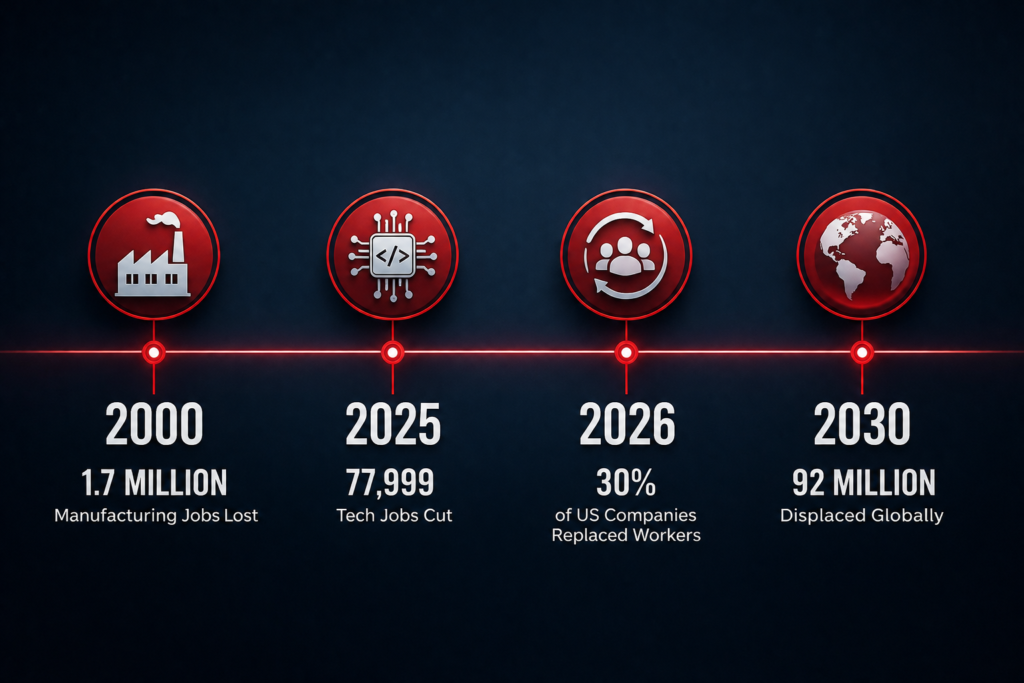
At the same time, the same WEF report projects that AI will create 170 million new roles globally by 2030, while displacing 92 million, a net gain of 78 million jobs.
New roles growing fastest include AI Engineer (up 140%), Prompt Engineer, AI Solutions Architect, and Big Data Specialist. Professionals with specialized AI skills are already commanding salaries up to 56% higher than peers in identical roles who lack those skills.

3. Is AI Taking Over?
This is the emotional version of the job question, and it deserves an emotional answer alongside a factual one.
Yes, AI is taking over specific tasks. No, it is not taking over work as a human concept.
A Pew Research Center survey found that 64% of Americans believe AI will lead to fewer jobs over the next 20 years.
That anxiety is real and it makes complete sense given what people are watching happen around them. But the same research shows that most workers are experiencing AI as a task-changer, not a job-ender.
The technology is handling the parts of their role that were always the least interesting, repetitive processing, routine documentation, basic data retrieval and leaving the parts that actually require judgment, creativity, and relationships.
4. Will AI Replace Programmers and Coders?
This is one of the most searched specific-job questions in the US right now, and the answer is more complicated than either side of the debate wants to admit.
Entry-level software engineering job postings have already dropped measurably in the US. AI coding assistants like GitHub Copilot, Cursor, and Claude Code have compressed the time it takes a senior developer to do tasks that used to require a junior hire.
But senior developers who use AI tools as a force multiplier are more productive, more valuable, and harder to replace than ever. The job is changing from “writing code” to “directing an AI that writes code and knowing what’s wrong with what it produced.” That requires deeper engineering knowledge, not less.
MIT and Boston University research found AI-driven automation will affect roughly 11.7% of US labor in the near term, equivalent to $1.2 trillion in wage.
5. Can AI Think Like a Human?
This is the philosophical question that Americans keep coming back to, and it matters because the answer tells you a lot about where the real ceiling on AI replacement actually sits.
The short answer is: not yet, and maybe not in the way the question implies.
Current AI systems are extraordinarily good at pattern recognition, synthesis, prediction, and optimization within defined domains. They are not good at genuine creativity, producing something that has no precedent in their training data. They cannot navigate real-world moral ambiguity with the judgment that humans apply.
6. Will AI Replace Doctors and Teachers?
Bill Gates said in March 2025 that within ten years, AI will have replaced many doctors and teachers, and that humans won’t be needed for most things. That quote went viral. It was the kind of statement that made people put down their coffee and stare at the wall.
Here’s the reality check: AI is already doing parts of those jobs. Medical transcription is 99% automated. AI diagnostic tools are reading radiology scans faster and sometimes more accurately than human radiologists on specific narrow tasks.
But replacing a doctor means replacing the ability to sit across from a frightened patient, interpret ambiguous symptoms that don’t fit a clean pattern. No AI system in 2026 is close to that.
Teaching has similar dynamics: AI can deliver content, quiz students, and adapt pacing. It cannot notice that a kid is struggling for reasons that have nothing to do with the material.
7. How Many Jobs Has AI Replaced So Far?
People want numbers, not projections. Here’s what the actual count looks like.
Since 2000, 1.7 million manufacturing roles have been lost to automation. By 2027, 7.5 million data entry and administrative roles could disappear.
Demand Sage’s comprehensive 2026 AI job replacement statistics report found that 23.5% of US companies have already replaced workers with ChatGPT or similar tools, and among those, 49% report that employees were directly replaced rather than transitioned into new roles.
Around 30% of US companies have replaced workers with AI tools and that number is expected to rise to 38% by the end of 2026.
One in six employers expects AI to reduce headcount this year. That’s not a distant alarm. That’s a quarterly planning decision being made in conference rooms right now.
8. Will AI Replace Content Writers and Creative Jobs?
This one hits close to home for a lot of people, including the people reading this blog. The honest answer requires separating two different things: commodity content and genuine creative work.
Commodity content: Basic product descriptions, templated email sequences, is already being produced at scale by AI. Marketing agencies are using AI to generate social captions, and ad copy variations at a fraction of what they were paying human writers for that work. That pipeline is gone for a lot of junior writers and it’s not coming back.
Genuine creative work: Original ideas, compelling storytelling, sharp opinions with a real point of view, content that takes a stand, is actually becoming more valuable, not less. Because the internet is now flooded with AI-generated sameness, the content that feels distinctly human, specific, and earned stands out more than it ever did.
9. Is AI Good or Bad for America?
On the positive side: productivity growth nearly quadrupled in industries most exposed to AI, rising from 7% to 27% between 2018 and 2024. AI is projected to contribute up to $19.9 trillion to the global economy by 2030.
The Trump administration secured commitments in September 2025 from major companies including Google, which pledged $1 billion toward AI education and job training for American students and workers. Micron announced $200 billion in manufacturing and R&D investment expected to create 90,000 American jobs in AI-adjacent hardware sectors.
On the negative side: the disruption is not happening evenly. Women face disproportionate risk due to higher concentration in administrative and service roles.
Workers aged 22 to 25 are already seeing employment declines in entry-level AI-exposed positions. The communities built around manufacturing, customer service, and data processing are the ones absorbing the displacement.
The Information Technology and Innovation Foundation’s December 2025 analysis found that, through 2024, AI’s job creation effects were actually outpacing its displacement effects, primarily because the AI boom generated massive employment in data center construction, hardware manufacturing, and AI development itself.
10. What Can I Do to Not Get Replaced by AI?
This is the most important question of all ten, and it’s the one people are most desperate for a practical answer to.
According to Final Round AI’s comprehensive job displacement research, by 2030, McKinsey projects 70% of job skills will need to change. That’s not a warning about a specific job, it’s a warning about every job.
Here’s what the data suggests actually works:
First, learn to use AI tools fluently in your field. The people commanding salaries 56% higher than their peers are not the AI researchers, they’re the marketers, lawyers, accountants, and designers who integrated AI into their existing expertise. The tool doesn’t replace you. You pointing the tool at a problem is the new skill.
Second, invest heavily in the skills AI cannot replicate: complex judgment calls, relationship-building, ethical reasoning, leadership under genuine uncertainty, and creative originality. These are not soft skills. These are the hard skills of 2026.
Third, look honestly at what percentage of your current job involves tasks that AI can already do. If the answer is more than 60%, the disruption is closer than most people want to admit. Getting ahead of it now, through upskilling, career pivoting, or repositioning within your industry, is a better strategy than waiting to see what happens.
The Bottom Line
AI will not replace humans. That framing misunderstands what AI actually is and what work actually requires.
What AI will do is replace humans who refuse to adapt and it’s already doing that, for the specific people in the specific roles that were always primarily task-execution rather than judgment, creativity, or connection.
The workers who thrive in the next decade will be the ones who stopped treating this as a binary replacement or not replaced and started treating it as a continuous upgrade problem. The tool is getting better every six months. The question is whether you’re getting better faster than the tool is getting cheaper.
That’s the real answer to “will AI replace humans?” The answer is: some of them, yes. Which ones are entirely up to you.
Disclaimer: This blog is for informational purposes only. All statistics cited are from publicly available research as of 2026 and are subject to revision as new data becomes available.
Sources:


