

Share Your Thoughts And Challenge Them On Reddit

Sharing Your Thoughts Is Useless Unless You’re Willing to Have Them Challenged
Here’s something nobody on Reddit wants to hear.
Posting your opinion and then defending it against every single reply isn’t “standing your ground.” It’s just talking to yourself in a crowd. You’re not debating anymore. You’re performing.
We’ve built this entire internet culture around sharing thoughts; hot takes, Substack posts, Reddit threads, quote tweets, LinkedIn manifestos. Everyone has something to say. And the louder you say it, the more engagement you get.
The Comfortable Illusion of Being Heard
When you post an opinion online and people agree, it feels like validation. When someone pushes back, it feels like an attack. That’s the trap right there.
Most people treat disagreement as a threat to manage, not as information to process. So they double down. They find the weakest version of the opposing argument and demolish it.
The thought never actually gets tested. It just gets performed.
Research out of Michigan Ross found that echo chambers on Reddit genuinely distort people’s perception of political norms. When you only ever see agreement, you start to think your view is the default and that anyone who disagrees is an outlier. That’s not clarity. That’s a filter bubble doing its job.

A 2025 study in the International Social Science Journal compared “echo chambers” to “plural spaces” on Reddit and found that the homogeneous ideological spaces, the ones where everyone already agrees, trigger measurably more uncivil and polarizing speech. The irony is brutal. The communities that feel the safest are often the ones doing the least real thinking.
Where Gen Z Is Actually Living
Modern discussions don’t happen in classrooms or town halls anymore, at least not primarily. Younger generations increasingly form opinions, sharing ideas, and challenge perspectives through online communities where conversation moves fast and diverse.
Research published in 2025 shows that for Gen Z, online debates have become the primary arena for developing political and social views. The problem is that many of these “debates” are structured more like performances than genuine exchanges.
Here’s where the real conversations are actually happening right now:
It remains one of the strongest platforms for long-form discussion and opinion exchange. A 2025 academic paper challenged the long-held assumption that Reddit is more resistant to polarization than Twitter or Facebook. Turns out, the echo chamber problem is alive and well there too. But the platform still rewards nuanced arguments in a way that most social media simply doesn’t.
Discord
It was started as a gaming platform and quietly became one of the most interesting discussion environments on the internet. Real-time conversations in topic-based servers allow for the kind of back-and-forth that social media’s asynchronous format kills.
Quora
That encourage structured question-and-answer exchanges where multiple perspectives compete for the same audience. The best answers get promoted not because they’re loud but because they’re actually useful.
X (formerly Twitter)
X is where trends and public opinions get stress-tested in real time. Ideas either survive the reply section or they don’t. Gen Z has made X one of its primary activism platforms, but the speed of the platform means nuance is often the first casualty.
The common thread across all of these platforms? The most valuable conversations rarely happen when everyone agrees. These communities grow because they reward curiosity, disagreement, and the willingness to reconsider.
Why Most Online Discourse Is Just Applause Fishing
Think about the last time you read a popular opinion post on Reddit or Twitter.
Did they say “that’s a fair point I hadn’t considered”?
Or did they say “you clearly didn’t read what I wrote”?
The second response is almost universal, because the goal was never to refine the idea. The goal was to be agreed with.
Frontiers in Sociology published research in 2026 showing that Reddit’s ranking system privileges content that generates strong emotional responses within a community. Highly upvoted posts don’t reflect community consensus. They reflect content that made the most people feel validated, which is a very different thing.
A CHI 2023 study that analyzed 155 million Reddit comments found something that’s both fascinating and uncomfortable: subreddits with upvotes and downvotes actually showed more deliberative and civic discourse than subreddits with no reaction mechanisms at all. The problem isn’t the voting itself. It’s what people decide to vote for.
Reddit Answers: When the Platform Starts Thinking For You
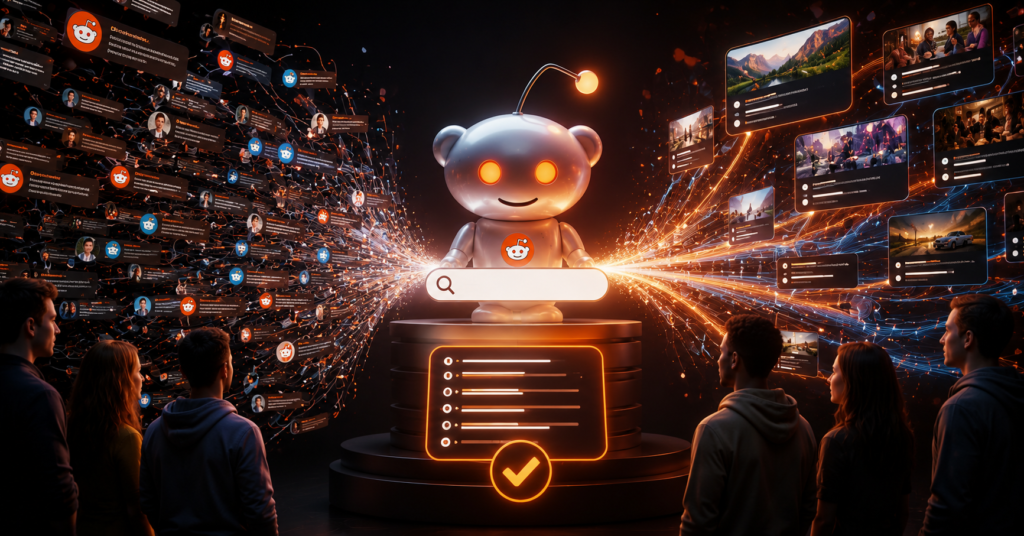
Reddit’s answer to the noise problem is called Reddit Answers, an AI-powered chatbot built on Google Gemini that scans Reddit’s entire content library and spits out bullet-point summaries in response to any question you type.
It launched in late 2024, rolled out to the US first, and has been expanding globally through 2025. The pitch is simple: instead of sifting through 47 comments to find the one useful reply buried at the bottom, you ask a question and the AI does the reading for you.
Reddit’s VP of Product, Serkan Piantino, was clear that the tool is meant to bridge users to Reddit’s content, not replace the actual discussions. CEO Steve Huffman called it “one of the few products that touches everything,” which, if you read between the lines, means it’s also a monetization play.
What Actually Changes Your Mind
Not a good enough argument, usually. Studies on belief updating show that most people don’t change their minds when they encounter contradictory evidence. They rationalize the evidence away.
What actually shifts minds is relationship, trust, and the feeling of being genuinely understood before being challenged.
Psychologists at Porter and Schumann studied intellectual humility across four studies and found something worth sitting with. People with higher intellectual humility were meaningfully more open to learning about opposing views during disagreements.
The Conversation covered this research in depth, pointing out four core aspects of intellectual humility: being open-minded (avoiding dogmatism), being curious (seeking new ideas), being realistic (owning your flaws), and being willing to revise your beliefs when the evidence warrants it.
That posture, in practice, looks like this:
- Listen to the challenge before you prepare your rebuttal
- Ask “what would actually change my mind about this?” before you hit post
- Acknowledge the strongest version of the opposing view, not the weakest
- Be willing to say “I was wrong about this part” without feeling like you lost
The Practical Challenge
Next time you post an opinion, whether it’s on Reddit, Discord, LinkedIn, or a WhatsApp group, try this before you hit post.
Write one sentence that starts with: “I could be wrong about this if…”
If you can’t finish that sentence, you don’t have an opinion. You have a belief you’ve stopped examining.
Berkeley’s Greater Good Science Center describes this as a core component of intellectual humility, the recognition that your beliefs might be wrong, and the willingness to reflect on how and why your views have evolved over time.
The same research notes that people with greater intellectual humility tend to make better decisions, collaborate more effectively, display less “my-side bias,” and are actually more trusted as leaders.
Found this worth arguing with? Good. Drop a comment and mean it.


