

The Nasdaq at 30,000 by 2027?

It sounds like a number someone made up to sell newsletter subscriptions.
Thirty thousand. The Nasdaq, the index that hosts Apple, Nvidia, Meta, Amazon, and practically every tech company that matters, is hitting 30,000, roughly 22% above where it trades today.
But here’s the thing: the analysts saying it aren’t the ones who told you Bitcoin was going to $1 million. These are sober, spreadsheet-wielding people at places like Motley Fool and LPL Financial, and the argument they’re making has an uncomfortable amount of logic behind it.
So let’s take it seriously and then stress-test it.
Where the Nasdaq Stands Right Now
The Nasdaq Composite currently trades around 26,000. It has gained roughly 102% over the past three years, nearly double the S&P 500’s 72% gain over the same period. The reason is straightforward: tech companies have been delivering earnings growth that most other sectors can’t touch, driven overwhelmingly by the AI investment supercycle.
For the index to hit 30,000, it needs to climb about 22% from its current level. In isolation, that’s not outrageous. The Nasdaq has done that and more in single-year runs before.
The question is whether the fuel is still in the tank.
The Bull Case: Why 30,000 Is Plausible
The case starts and ends with AI infrastructure spending.
NVIDIA has projected that it expects to move approximately $1 trillion worth of its Vera Rubin and Blackwell processors across 2026 and 2027 combined. That’s not a forecast from an optimistic intern; that’s the company’s own guidance, backed by a pipeline of enterprise and hyperscaler orders that shows no sign of cooling.
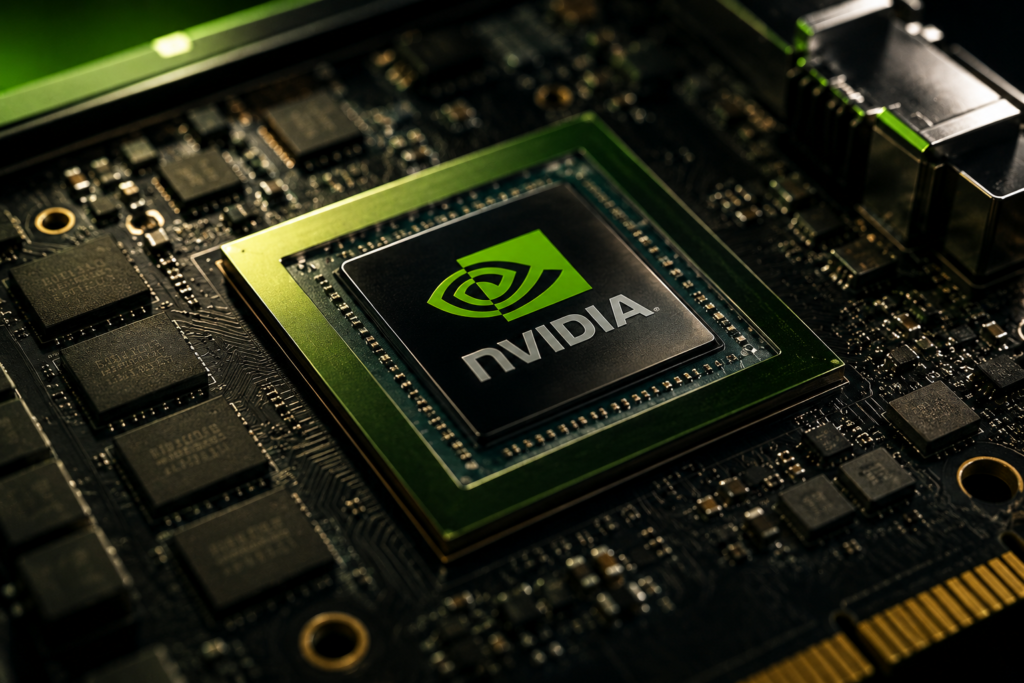
NVIDIA’s adjusted earnings per share are expected to grow 75% this year alone, following a 60% spike last year. Analysts are then forecasting another 35% increase the year after. Even at conservative multiples, that kind of earnings trajectory pulls the stock price and the index considerably higher.
TSMC, which manufactures the chips Nvidia designs, is projecting compound annual growth in AI accelerator chip sales in the high 50s through 2029. If TSMC hits its 2027 earnings targets and trades at 30 times earnings (actually a discount to current Nasdaq multiples), analysts see its stock reaching $575, a 57% upside from today.
Multiply these dynamics across the dozens of AI-adjacent companies in the index. Microsoft, Meta, Amazon, Alphabet, Broadcom, and the math starts to look less like a headline and more like arithmetic.
LPL Financial has noted that tech sector earnings estimates have actually risen by more than 6% since the start of 2026. Analysts broadly expect tech earnings to have spiked 44% in Q1 2026 alone.
The Bear Case: What Could Kill the Rally
Let’s not be credulous about this.
The Nasdaq has been under stress, to put it politely, at several points over the past three years. Trump-era tariff uncertainty rattled markets, and geopolitical tensions, particularly around the Middle East, have created periodic volatility that no earnings forecast can fully absorb.
There are also structural risks specific to AI stocks:
Valuation multiples are not cheap. The Nasdaq-100’s average earnings multiple sits at around 32.4. That’s a level that prices in a lot of future perfection. When expectations are this high, even a modest earnings miss can trigger disproportionate selloffs.
AI capex is enormous. The major hyperscalers like Microsoft, Google, Amazon, and Meta are collectively spending hundreds of billions on AI infrastructure. If the return on that investment doesn’t materialize as quickly as the market expects, sentiment can shift fast.
Competition is arriving. Cheaper AI models from China (DeepSeek being the most notable recent example) have already caused at least one significant Nvidia selloff. The pricing power that supports the bull case isn’t guaranteed.
Interest rates matter. Tech stocks are long-duration assets. Their valuations depend heavily on future earnings discounted back to today. If rates stay high or rise, those future earnings are worth less in present-value terms, and multiples compress.

The Honest Verdict
30,000 by 2027 is not a fantasy. Given the AI earnings trajectory, the concentration of tech giants in the index, and the momentum that’s already built up, it is a plausible scenario under conditions where nothing goes dramatically wrong.
But “nothing goes dramatically wrong” is doing a lot of heavy lifting in that sentence.
Markets at elevated valuations need catalysts to keep going and require very few stumbles. The Nasdaq’s run over the past three years has been fueled by real earnings, not just hype, but the bar for what counts as good enough gets higher every quarter.
If you’re an investor watching this, the key questions to ask aren’t “will it hit 30,000” but rather: “What is my exposure if it doesn’t?” and “Am I confusing a good story with a good investment at this specific price?”
A rising tide lifts all boats. But it also hides all the rocks.
Disclaimer: This article is for informational purposes only and does not constitute investment advice. Consult a qualified financial advisor before making investment decisions.
Sources: Motley Fool (April 2026) | CoinPriceForecast NASDAQ Model | LPL Financial Q1 2026 Earnings Report


