
JNJ’s $5.5B Talc Settlement: What Every Investor Needs to Know Right Now

J&J just made the biggest legal move in its history. The stock moved. And now every investor has the same question:
Is this actually good news, or just the beginning of another headache?
Here is everything you need to know, broken down clearly.
What Just Happened
On July 27, 2026, Johnson and Johnson announced a $5.5 billion proposed settlement to resolve its remaining talc lawsuits.
Here is the fast version:
- 76,000 ovarian cancer claims are covered in this deal
- The settlement covers 99.75% of all remaining talc lawsuits
- First payment of up to $3 billion is scheduled for 2027
- No additional payments are due before 2028
- The deal requires 95% of claimants to participate before it becomes final
- It still needs federal court approval to go through
JNJ shares rose 1.4% after hours when the news dropped, then climbed another 3% in extended trading. The market liked it.
But the market does not always have the full picture right away. Let us dig into what this actually means.
Why J&J Settled Now – And Why It Actually Makes Sense
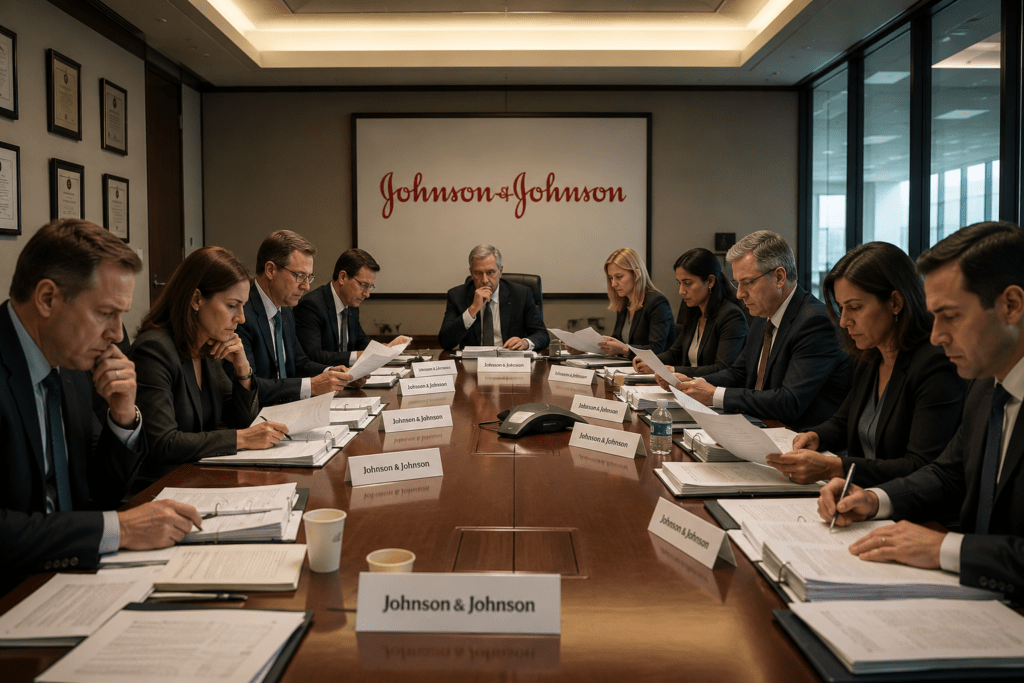
Two things shifted the balance of power right before this announcement.
1. The MDL court ruled against plaintiffs on causation:
A federal judge found that plaintiffs could not prove J&J’s talc specifically caused any individual’s ovarian cancer. That is the single hardest thing to prove in a product liability case, and losing it weakened the plaintiffs’ position significantly.
2. J&J won an individual trial the week before:
A pattern of court wins, combined with disqualified plaintiff expert witnesses, meant J&J was not settling from a position of weakness. It was settling from strength.
Erik Haas, J&J’s VP of Litigation, confirmed this directly: “While we are confident the company would have ultimately prevailed with further litigation, this resolution allows the company to put this matter behind it.”
Translation for investors:
J&J chose certainty over a longer fight. And with $21 billion in annual free cash flow, it can comfortably afford to.
The Settlement Details – Everything in One Place
Deal Structure at a Glance:
| Detail | What It Means |
| Total commitment | $5.5 billion (potentially $7B+ depending on participation) |
| Claims covered | 76,000 ovarian cancer cases – 99.75% of remaining claims |
| First payment | Up to $3 billion in 2027 |
| Second payment | No additional payments due before 2028 |
| Participation required | 95% of claimants must agree or deal does not happen |
| Court approval | Still required from federal MDL judge |
| Future claims covered | No – only existing claims |
| UK litigation | Not included – 7,000+ UK claimants in separate ongoing case |
| Bankruptcy route | Abandoned – this is a direct settlement |
The one number every investor should remember: The deal is uncapped. Attorney Chris Seeger, who helped negotiate it, says J&J could ultimately pay $7 billion or more depending on final participation levels.
What This Means for JNJ Stock
The market reacted positively. Here is why that makes sense.
The talc litigation was not just a legal problem. It was a valuation problem. Institutional investors were pricing uncertainty into JNJ’s multiple for years because of this. With 99.75% of claims potentially gone, that uncertainty lifts.
What changes for JNJ after this settlement:
- The biggest legal overhang on the stock largely disappears
- Management attention shifts back to the actual business – oncology, MedTech, robotics
- Institutional investors can price JNJ on fundamentals rather than legal risk
- The dividend is not at risk – $21 billion in free cash flow covers the $3B payment comfortably
What stays the same:
- The stock is still trading at a premium – P/E of 30.82x vs its 5-year median of 23.77x
- The UK litigation with 7,000+ claimants is completely unresolved
- Future talc claims are not covered by this deal
- Insiders have sold $8.2 million in stock with no purchases reported recently
JNJ Dividend King: 64 Years of Increases – and Why It Could Keep Going
This is one of the most searched facts about JNJ right now. And it deserves its own section.
JNJ has raised its dividend for 64 consecutive years. That means it increased its payout through:
- The 2008 financial crisis
- Multiple patent cliffs
- A global pandemic
- A decade of product liability lawsuits
- Three failed bankruptcy attempts
And it still raised the dividend every single year.
On April 14, 2026, J&J raised its quarterly dividend from $1.30 to $1.34 per share – a 3.1% increase – extending the streak to 64 years.
JNJ Dividend History and Key Numbers
| Metric | Value |
| Consecutive years of increases | 64 years (Dividend King status) |
| 2026 quarterly dividend | $1.34 per share |
| 2026 annual dividend | $5.36 per share |
| Dividend yield (current) | ~2.2% |
| Healthcare sector average yield | 1.8% |
| Payout ratio | 46% (down from 84% a year ago) |
| Free cash flow (FY 2025) | $19.7 billion |
| Free cash flow target (FY 2026) | $21 billion |
| 10-year average dividend growth rate | 5.7% per year |
| Dividend growth from 2008 to 2026 | $0.46 per share to $1.34 per share |
| AAA credit rating | Yes – one of only two US companies |
Why the dividend streak is safe:
- The $3 billion 2027 settlement payment is easily covered by $21 billion in projected free cash flow
- The payout ratio dropped sharply from 84% to 46% – a healthy sign
- EPS is projected to grow 28% over the next 3 years, giving even more headroom
- J&J generates roughly $1.5 billion in free cash flow every single quarter
The income investor’s bottom line: The dividend is not going away. It has survived everything the last six decades threw at this company. A $5.5 billion settlement that gets paid over two years is not going to break a streak that survived a global financial crisis.
The Business Behind the Headlines
The talc settlement is dominating coverage today. But here is what J&J’s actual business looks like right now:
Q1 2026 Key Numbers:
- Total revenue: $24.06 billion – up 9.9% year over year
- Innovative Medicine revenue growth: 11.2%
- MedTech revenue growth: 7.7%
- Darzalex (oncology): $3.96 billion, up 22.5%
- TREMFYA (immunology): Up 68.3%
- Full-year 2026 revenue guidance: $100.8 billion to $101.4 billion
Three big growth drivers to watch:
- Darzalex – the multiple myeloma blockbuster growing at 22.5% annually
- OTTAVA – J&J’s surgical robot submitted for FDA approval in January 2026, expected commercial launch by year-end
- DePuy Synthes – Bloomberg reported J&J is exploring selling this orthopedics division for $20 billion+, which would free up massive capital for buybacks and pipeline investment
Disclaimer: This blog is for informational and educational purposes only and does not constitute financial or investment advice. Always consult a qualified financial advisor before making investment decisions.All market data cited is from publicly available sources.
Sources:
- J&J Official Press Release — Proposed Resolution of Ovarian Talc Litigation
- 24/7 Wall St. — Johnson and Johnson Raises Dividend for 64th Consecutive Year
- TIKR — Johnson Johnson Stock Hits 64 Straight Years of Dividend Growth
- GuruFocus — JNJ Valuation and Dividend Analysis After Settlement
- Insurance Journal — Settlement Details and Attorney Quotes
- Al Jazeera — UK Litigation Remains Open
- Simply Wall St — JNJ Dividend History and Sustainability